Physical Address
304 North Cardinal St.
Dorchester Center, MA 02124
Physical Address
304 North Cardinal St.
Dorchester Center, MA 02124


Vanessa BuschschlueterBBC News Online Latin America Editor
 Reuters/Leonardo Fernandez Viloria
Many watching U.S. President Donald Trump’s press conference on Saturday were probably hoping to hear the dramatic details of how U.S. troops captured Venezuelan leader Nicolás Maduro in a predawn raid.
But arguably the more surprising moment came when Trump announced that now that Maduro had been detained, the United States would “manage” Venezuela “until we can achieve a safe, appropriate and sensible transition.”
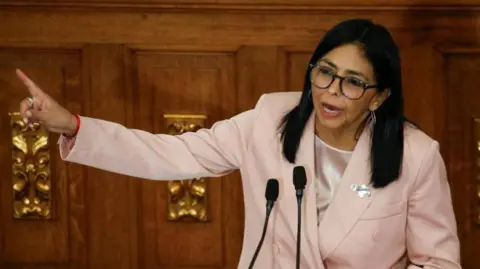
In another unexpected development, he added, Secretary of State Marco Rubio has been talking to Maduro’s Vice President Delcy Rodriguez, who he said is “basically willing to do what we think is necessary to make Venezuela great again.”
Rodriguez, however, seemed less cooperative at a later press conference of her own, denouncing Maduro’s detention as kidnapping and stressing that Venezuela would not be colonized.
Given this conflicting information, many are asking who is now in charge in Venezuela.
According to the Venezuelan constitution, if the president is absent, the vice president takes over.
So, on the face of it, Venezuela’s Supreme Court ruling that Delcy Rodriguez is the country’s acting president seems like a logical step.
But most Venezuela observers had expected the consequences of the U.S. intervention to be different.
The United States and many other countries do not recognize Nicolás Maduro as Venezuela’s legitimate president and have condemned the 2024 election as rigged.
Maduro was declared president by Venezuela’s Electoral Commission (CNE), which is dominated by government loyalists.
But the CNE never provided detailed vote counts to support their claims, and copies of the tally collected by the opposition and reviewed by the Carter Center showed that opposition candidate Edmundo Gonzalez won in a landslide.
 Juan Barreto/AFP via Getty Images
In light of this, the United States and dozens of other countries recognized González as president-elect.
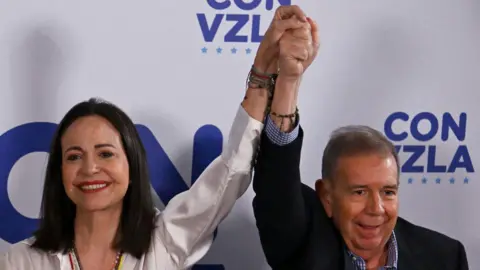
Gonzalez is a little-known former diplomat who has the backing of popular opposition leader María Collina Machado, whom he replaced on the ballot after she was barred from running for office by Maduro government officials.
After the election, González went into exile in Spain and Machado hid in Venezuela as security forces cracked down on the opposition.
They have spent the past 18 months urging Maduro to step down and lobbying for international support for their cause, particularly from the United States.
Machado’s profile increased when she won the Nobel Peace Prize for her “struggle for a just and peaceful transition from dictatorship to democracy” in Venezuela.
Her perilous journey from her hideout in Venezuela to Oslo to accept the award brought her to public attention and recognition, with many believing that any post-Maduro scenario would see her return to her home country to take power alongside Edmundo González.
After Maduro’s arrest, Machado himself published a letter on social media declaring that “the moment of freedom has arrived.”
“Today, we are ready to carry out our mission and seize power,” she wrote.
But the US president stunned journalists when he announced that Machado had no “support or respect” to lead the country.
Trump said his team had not spoken to Machado after the U.S. airstrike, but Marco Rubio had spoken to Delcy Rodriguez.
Trump’s next words may answer why the Trump administration is now Maduro’s loyal lieutenant — at least for now.
Trump quoted Rodriguez as saying “we’ll do whatever you want,” adding that “she really had no choice.”
With Maduro’s inner circle appearing to remain in power in Venezuela, U.S. officials may believe that taking over with someone from the current administration would provide the smoothest transition.
President Trump said at a press conference that “the United States is ready to launch a second, larger attack if necessary,” which seemed to explain why he believed Delcy Rodriguez had no choice but to follow U.S. orders.
 Gaby Oraa/Bloomberg via Getty Images
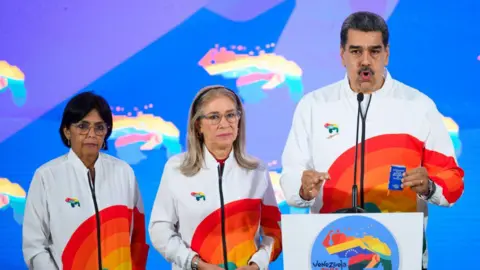
The fact that Rodriguez was seen surrounded by some of the most powerful people in Maduro’s inner circle, hours after the president was arrested and flown out of the country, seemed to suggest she had won their support, too.
She was flanked by her brother Jorge Rodriguez (President of the National Assembly of Venezuela), Interior Minister Diosdado Cabello, Defense Minister Vladimir Padrino and Supreme Commander of the Armed Forces Domingo Hernandez Lares, among others.
That would please U.S. officials, who fear that capturing Maduro could lead to a potentially volatile battle for control among his inner circle.
But Delcy Rodriguez’s message to America may not be a good one.
She insisted that “Venezuela has only one president and his name is Nicolás Maduro” and called his seizures a “kidnapping.”
“We will never again be a colony of any empire,” she insisted, pledging to “defend” Venezuela.
While she certainly doesn’t sound like someone who is “willing to do the bidding of the United States,” as Trump puts it, there is speculation that she may have been firing off nationalistic rhetoric to keep Maduro’s most loyal supporters on board.
Asked about Trump’s support for Rodriguez and his remarks, Marco Rubio told CBS on Sunday that the United States would be evaluated based on her actions, not her words.
“Do I know what people will decide? I don’t know,” he added, seemingly suggesting he was less certain than Trump was about Rodriguez’s willingness to cooperate with the United States.
What he insisted on was the United States’ willingness to put pressure on Rodriguez’s interim government.
“I do know that if they don’t make the right decision, the United States will retain a number of levers to ensure that our interests are protected, including imposing oil quarantines and so on,” he said.
In an interview with ABC, Rubio also appeared to suggest that Venezuela should hold new elections.
“The government will go through a transition period and a real election, which they have not experienced,” he told The Week.
He also appealed for “realism”, suggesting that new elections would take time: “Everyone is asking why, 24 hours after Nicolás Maduro was arrested, there are no elections scheduled for tomorrow? This is ridiculous.”
There is no doubt that talk of new elections will disappoint not only Maria Corina Machado and Edmundo González, but also the many Venezuelans who voted for them and firmly want to see those votes honored.
The opposition has long insisted that free and fair elections are impossible and that key institutions involved in organizing them are loyal supporters of Maduro. Reform of these institutions will take time.
So, in the short term, Venezuela looks likely to be governed by Delcy Rodriguez and Maduro’s inner circle – as long as they meet the expectations of the Trump administration.
How long this situation lasts will depend on whether Rodriguez can find the golden middle between meeting Trump’s demands and Maduro’s fundamental interests.
She may soon find herself between a rock and a hard place.





