Physical Address
304 North Cardinal St.
Dorchester Center, MA 02124
Physical Address
304 North Cardinal St.
Dorchester Center, MA 02124

The military operations in the Middle East since Saturday, February 28 have disrupted monetary policy expectations. The longer they last, the stronger the impact on future monetary policy.
However, the forecast for the end of February is quite optimistic. The U.S. inflation rate has just fallen to 2.4% (measured by CPI), the spot inflation rate is low, and the market is expected to cut the U.S. federal funds rate at the June monetary policy meeting, and Kevin Warsh will take over as chairman of the Federal Reserve. It was expected to benefit from a favorable price environment, but due to the conflict in the Middle East, everything has been called into question.
The impact on oil and gas prices has been significant due to the closure of the Strait of Hormuz and military strikes targeting oil and gas facilities around the Persian Gulf.
Clearly, higher energy prices will push up nominal inflation, at least in the short term. However, there is one major uncertainty: time. About a month later, oil prices remained above $90 (here based on US crude oil), and the effect became evident in short-term inflation. If high energy prices persist for more than three months, the impact will become more structural and extend to the prices of many goods and services. However, nothing is certain: downward pressure on prices could also emerge if geopolitical tensions significantly slow global economic growth. But for now, the focus remains on rising energy prices due to geopolitical factors.
Is it still possible that the Fed will cut interest rates this summer under Kevin Warsh? Yes, but only if the geopolitical and energy situation around the Persian Gulf and Strait of Hormuz returns to normal by the end of April.
Multiple indicators indicate that the market currently does not expect the Federal Reserve to cut interest rates before 2027. Of course, this situation can develop quickly:
• The trend in the two-year Treasury yield is considered the best predictor of Fed policy. Two-year Treasury yields have recently risen above the Fed’s current interest rate, broadly signaling that markets don’t expect a rate cut, or even a rate hike, to counter a rebound in inflation.
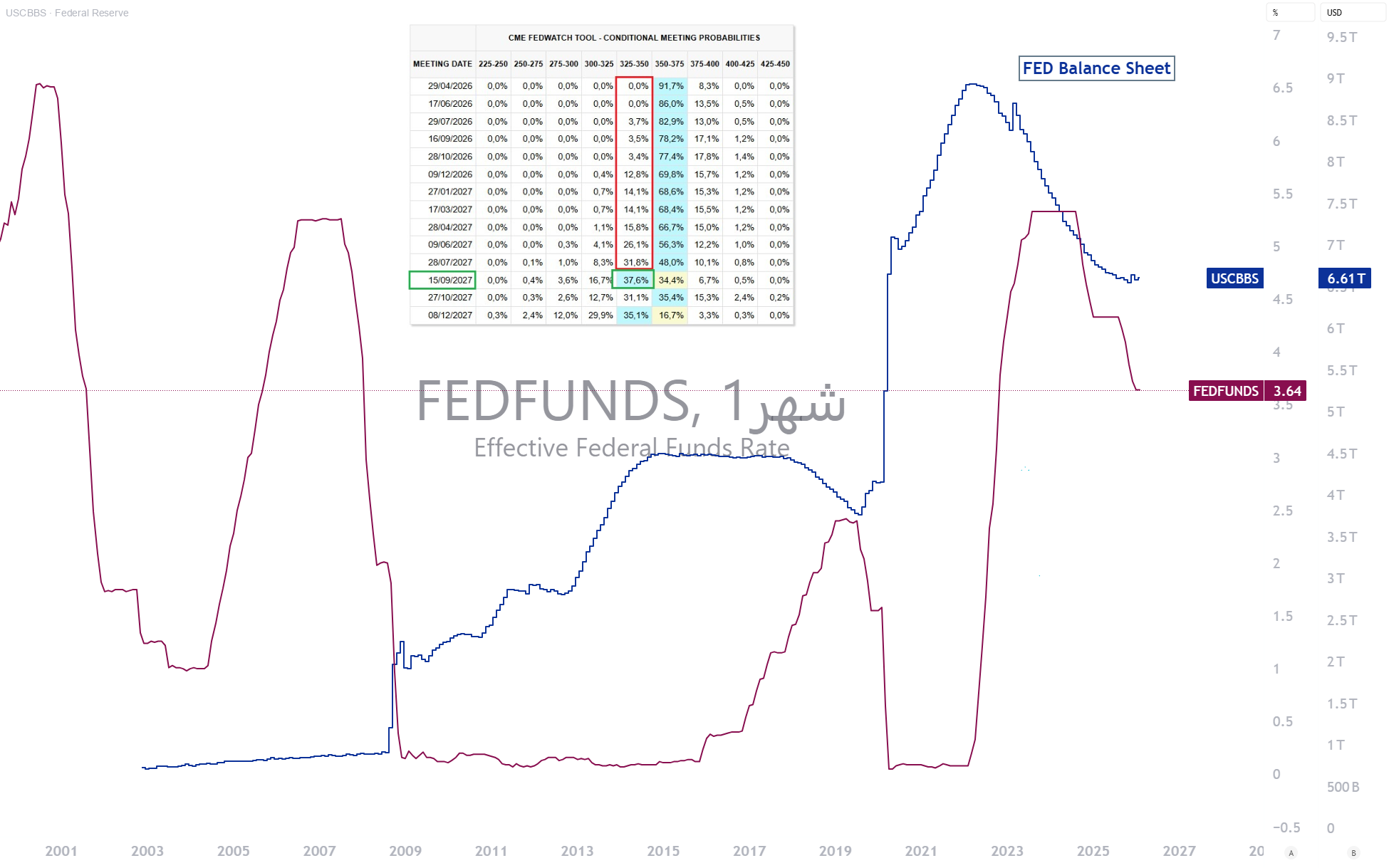
• CME Group’s FedWatch tool, based on U.S. federal funds rate futures contracts traded in Chicago, shows institutional investors don’t expect any rate cuts before mid-2027
The chart below shows CME Group’s FedWatch tool that the market is not expecting a rate cut until the end of 2027:
The chart below shows the daily Japanese candlestick for the 2-year U.S. Treasury yield:
Disclaimer:
This content is intended for individuals familiar with financial markets and instruments and is for informational purposes only. The ideas presented (including market commentary, market data and observations) are not the work of any research department of Swissquote or its affiliates. This material is intended to highlight market trends and does not constitute investment, legal or tax advice. If you are a retail investor or lack experience in trading complex financial products, it is recommended that you seek professional advice from a licensed advisor before making any financial decisions.
The content is not intended to manipulate markets or encourage any specific financial behavior.
Swissquote makes no representations or warranties regarding the quality, completeness, accuracy, comprehensiveness or non-infringement of such content. The opinions expressed are those of the advisor and are for educational purposes only. Any product or market-related information provided should not be construed as advice on investment strategies or trading. Past performance is no guarantee of future results.
In no event shall Swissquote, its employees and representatives be liable for any damages or losses arising directly or indirectly from decisions based on this content.
The use of any trademark or third-party trademark is for reference only and does not imply endorsement by Swissquote Bank or that the trademark owner authorizes Swissquote Bank to promote its products or services.
Swissquote is a subsidiary of Swissquote Bank Ltd (Switzerland) regulated by the Swiss Securities Regulatory Authority (FINMA), Swissquote Capital Markets Limited regulated by the Cyprus Securities and Exchange Commission (Cyprus), Swissquote Bank Europe SA (Luxembourg) regulated by the Cyprus Financial Supervisory Authority, Swissquote Ltd (UK) regulated by the Cyprus Financial Supervisory Authority, Swissquote Financial Services (Malta) Limited Event Marketing Brands of the Malta Financial Services Authority, Swissquote MEA Ltd. (United Arab Emirates) regulated by the Dubai Financial Services Authority, Swissquote Pte Ltd (Singapore) regulated by the Monetary Authority of Singapore, Swissquote Asia Limited (Hong Kong) regulated by the Hong Kong Securities and Futures Authority and Swissquote South Africa Limited (Pty) regulated by the Securities and Exchange Commission.
Swissquote products and services are available only to persons permitted to receive them by local law.
All investing involves some degree of risk. The risk of loss from trading or holding financial instruments can be substantial. The value of financial instruments (including, but not limited to, stocks, bonds, cryptocurrencies and other assets) may fluctuate up and down. There is a significant risk of financial loss when buying, selling, holding, betting or investing in these financial instruments. SQBE does not make any recommendation regarding any specific investment or transaction or the use of any specific investment strategy.
CFDs are complex instruments and carry a high risk of losing money quickly due to leverage. The vast majority of retail client accounts will suffer capital losses when trading CFDs. You should consider whether you understand how CFDs work and whether you can afford to take the high risk of losing your money.
Digital assets are unregulated in most countries, and consumer protection rules may not apply to them. As a speculative investment with high volatility, digital assets are not suitable for investors who cannot bear high risks. Make sure you understand each digital asset before trading.
Cryptocurrencies are not considered legal tender in some jurisdictions and are subject to regulatory uncertainty.
The use of Internet-based systems may involve high risks, including but not limited to fraud, cyberattacks, network and communications failures, and identity theft and phishing attacks related to digital assets.




