Physical Address
304 North Cardinal St.
Dorchester Center, MA 02124
Physical Address
304 North Cardinal St.
Dorchester Center, MA 02124

Oil prices: Is an inflationary shock inevitable? (For more information, please click on the image below)

In such a geopolitical context, positive shifts in favor of the energy and defense sectors are usually observed. Airlines, in contrast, are under pressure.
As part of a strategy to hedge the risk of a stock index correction, it can be interesting to look for leverage through industry stocks that “win” from current events. The energy sector naturally stands out, especially companies that benefit directly from the short-term rise in oil prices. Companies that sell shale oil, which is the most expensive to extract, are most sensitive to rising oil prices. However, caution must be exercised as the share prices of these companies react quickly to short-term spikes but could also fall if there is a geopolitical breakout. Such is the case with Vista Energy.
When oil prices rise, the following technical and fundamental factors dominate:
• Can drill quickly
• If price is high, production can be increased
• Significant increase in profit margins
• Significant increase in cash flow
• A company’s market capitalization typically rises but can fall rapidly in times of geopolitical calm
Vista Energy is an independent oil company founded in 2017 by former YPF director Miguel Galluccio. The company’s legal headquarters are in Mexico and it is listed on the New York Stock Exchange (NYSE: VIST), while the majority of its activities are concentrated in Argentina’s Vaca Muerta formation, one of the world’s largest unconventional hydrocarbon deposits. Vista has quickly become one of the country’s leading independent oil producers thanks to its development of shale oil extracted through horizontal drilling and hydraulic fracturing.
Vista’s business model makes the company highly sensitive to short-term oil price fluctuations. Like most exploration and production companies, the company sells oil at international market prices, which are typically tied to benchmarks such as Brent or West Texas Intermediate. However, once a well is on production, a large portion of operating costs (drilling, infrastructure, and operations) remain relatively stable. When the price per barrel increases, revenue per barrel increases immediately with minimal changes in costs, resulting in a disproportionate increase in profits and cash flow. This high sensitivity to oil prices explains why Vista Energy’s financial results and share price react quickly to oil market fluctuations.
However, the opposite is also true, as the trend could quickly reverse if oil prices fall again.
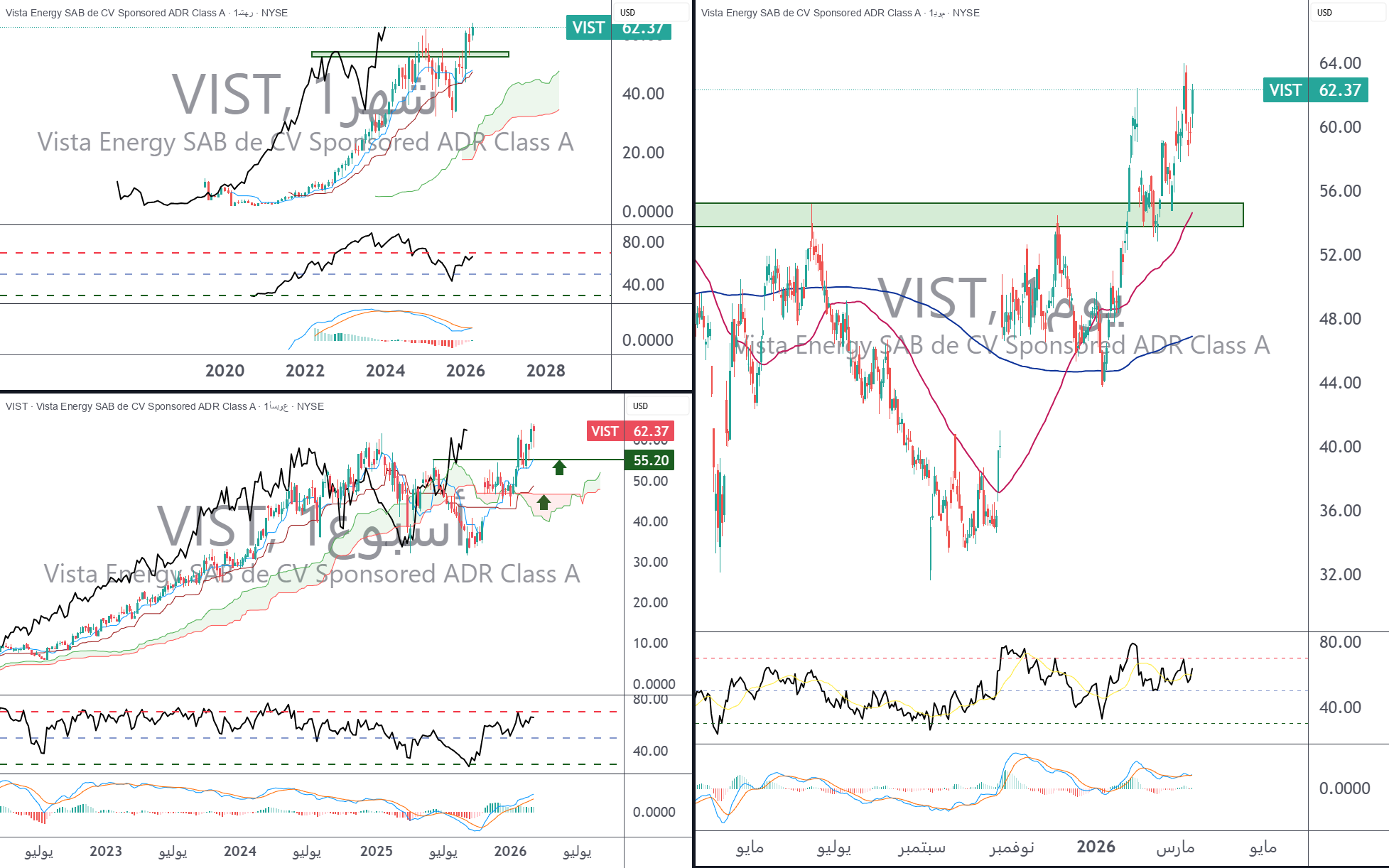
From the technical analysis of the financial market, the basic trend is upward, and the stock recently issued a technical continuation signal after breaking through the resistance level of $58 to $62. The chart below shows the monthly, weekly, and daily Japanese candlesticks for Vista Energy stock.
Disclaimer:
This content is intended for individuals familiar with financial markets and instruments and is for informational purposes only. The ideas presented (including market commentary, market data and observations) are not the work of any research department of Swissquote or its affiliates. This material is intended to highlight market dynamics and does not constitute investment, legal or tax advice. If you are a retail investor or lack experience in trading complex financial products, it is recommended that you seek professional advice from a licensed advisor before making any financial decisions.
The content is not intended to manipulate markets or encourage any specific financial behavior.
Swissquote makes no representations or warranties regarding the quality, completeness, accuracy, comprehensiveness or non-infringement of such content. The opinions expressed are those of the advisor and are for educational purposes only. Any product or market-related information provided should not be construed as advice on investment strategies or trading. Past performance is no guarantee of future results.
In no event shall Swissquote, its employees and representatives be liable for any damages or losses arising directly or indirectly from decisions based on this content.
The use of any trademark or third-party trademark is for reference only and does not imply endorsement by Swissquote Bank or that the trademark owner authorizes Swissquote Bank to promote its products or services.
Swissquote is a subsidiary of Swissquote Bank Ltd (Switzerland) regulated by the Swiss Securities Regulatory Authority (FINMA), Swissquote Capital Markets Limited regulated by the Cyprus Securities and Exchange Commission (Cyprus), Swissquote Bank Europe SA (Luxembourg) regulated by the Cyprus Financial Supervisory Authority, Swissquote Ltd (UK) regulated by the Cyprus Financial Supervisory Authority, Swissquote Financial Services (Malta) Limited Event Marketing Brands of the Malta Financial Services Authority, Swissquote MEA Ltd. (United Arab Emirates) regulated by the Dubai Financial Services Authority, Swissquote Pte Ltd (Singapore) regulated by the Monetary Authority of Singapore, Swissquote Asia Limited (Hong Kong) regulated by the Hong Kong Securities and Futures Authority and Swissquote South Africa Limited (Pty) regulated by the Securities and Exchange Commission.
Swissquote products and services are available only to persons permitted to receive them by local law.
All investing involves some degree of risk. The risk of loss from trading or holding financial instruments can be substantial. The value of financial instruments (including, but not limited to, stocks, bonds, cryptocurrencies and other assets) may fluctuate up and down. There is a significant risk of financial loss when buying, selling, holding, betting or investing in these financial instruments. SQBE does not make any recommendation regarding any specific investment or transaction or the use of any specific investment strategy.
CFDs are complex instruments and carry a high risk of losing money quickly due to leverage. The vast majority of retail client accounts will suffer capital losses when trading CFDs. You should consider whether you understand how CFDs work and whether you can afford to take the high risk of losing your money.
Digital assets are unregulated in most countries, and consumer protection rules may not apply to them. As a speculative investment with high volatility, digital assets are not suitable for investors who cannot bear high risks. Before trading, make sure you understand each digital asset.
Cryptocurrencies are not considered legal tender in some jurisdictions and are subject to regulatory uncertainty.
The use of Internet-based systems may involve high risks, including but not limited to fraud, cyberattacks, network and communications failures, and identity theft and phishing attacks related to digital assets.