Physical Address
304 North Cardinal St.
Dorchester Center, MA 02124
Physical Address
304 North Cardinal St.
Dorchester Center, MA 02124



Gold is caught between the specter of a sharp decline and the dream of a new all-time peak
Prepared by: Economic expert Mohammad Qais Abdul Ghani
introduce
Discussions are heating up about the start of a sharp decline in gold prices and a gradual return to the $3,000-per-ounce level. It is increasingly likely that the war in Russia and Ukraine will end, and that the Federal Reserve will stop cutting interest rates at its next meeting. There are also signs that the trade war between Washington and Beijing has subsided and trade relations in the electronic chip field have restored.
The basic question here is:
Will these developments be enough to quell gold fever and send prices back into negative territory below $3,000?
Or are we facing a natural correction in a larger upward path that could ultimately lead to a new all-time peak for gold?
This article attempts to dissect the economic, geopolitical and technological landscape and then translate it into a practical vision for all categories of gold traders: platform traders, physical gold investors, savers and cash speculators.
First: Economic Situation—The Fed’s Concern about Inflation
On the economic front, some core inflation data are still relatively lagging due to the impact of the previous U.S. government shutdown, but the market is awaiting the release of this week’s Core Personal Consumption Expenditure (Core PCE) index, the Fed’s preferred inflation measure.
This indicator is currently considered the most important data for gold this week, as it will determine the extent to which the Fed can continue to tighten policy or delay a rate cut:
•Any higher-than-expected reading would suggest more stubborn inflation, which could support interest rates remaining high for an extended period, which is a negative pressure factor for gold prices.
•Weak data could open the door to discussions of future monetary easing, which would provide a positive boost to gold prices in the medium term.
Additionally, this week is the American Thanksgiving holiday, which means:
• Reduced circulation liquidity.
• Spreads are wide.
• Severe and sometimes illogical fluctuations.
These factors require caution in short-term trading during this period.
Second: Geopolitical landscape – the possibility of moving from war to peace
On a geopolitical level, several factors are weighing on gold:
1. Russia-Ukraine Archives
There are signs that pressure is growing for a peace deal or settlement, with Ukraine being forced to accept proposals to end the crisis.
This war is one of the most important reasons for the rise in gold prices in recent times.
•Any true convergence towards peace usually translates into:
• Reduced demand for safe havens.
•Gold is under selling pressure.
2. Trade relations between Washington and Beijing
There has been renewed talk of reviving trade relations, particularly in electronic chips and processors, and allowing some movement in sensitive technology areas.
This understanding reduces the severity of the trade war and supports:
•US stock markets and indices.
•Risk appetite often comes at the expense of gold as a safe-haven asset.
These factors don’t necessarily spell the end of gold’s rally, but if coupled with negative technical data, they could create an environment ripe for a downward correction.
Third: Technical Interpretation of Gold Trends – Risk and Opportunity Levels
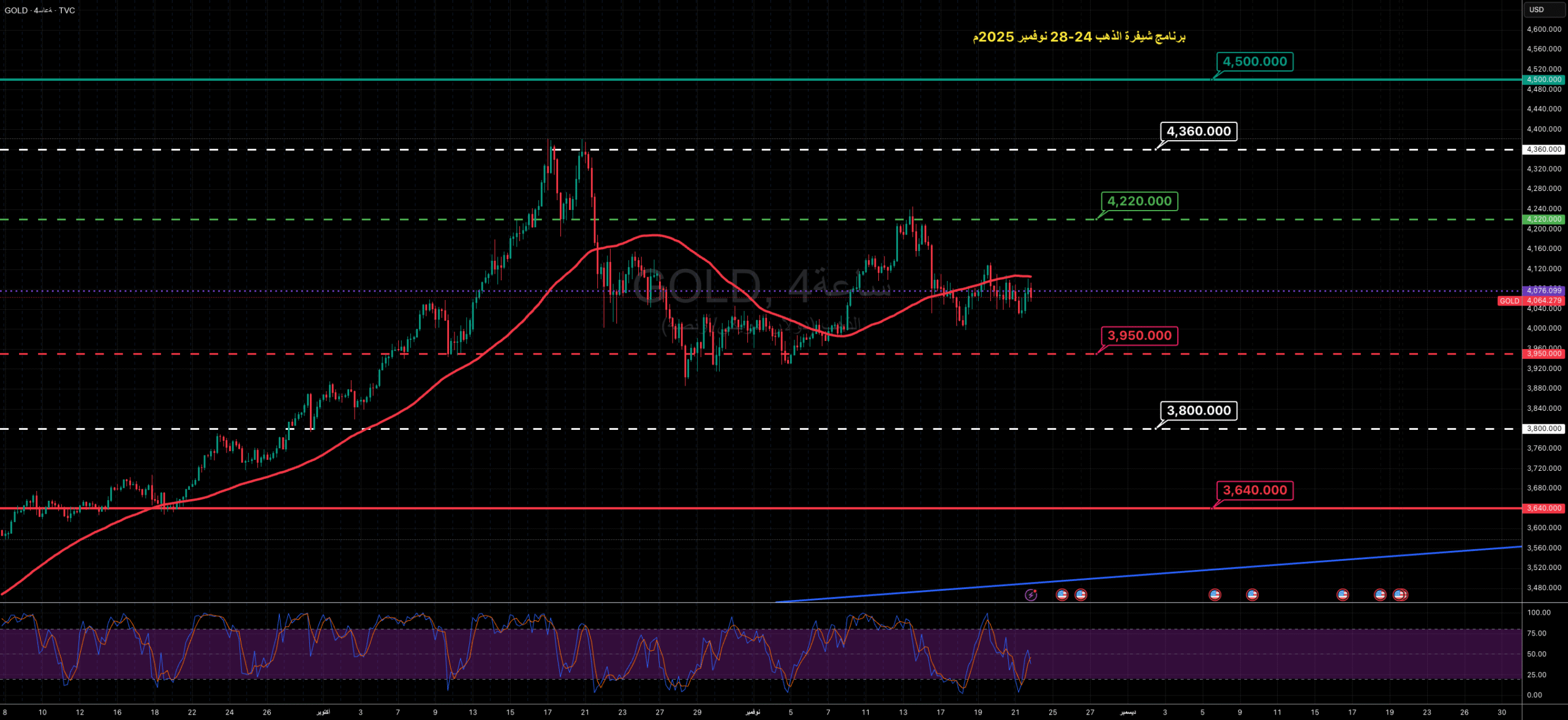
From a technical point of view, gold is still within the framework of an overall positive scenario in the medium term, but after experiencing a strong upward move and achieving significant gains, it is currently operating in a sideways range in the short term, located near the 55-day moving average.
This lateral movement usually happens in one of two ways:
1. Either continue to climb new heights.
2. Or enter a deep correction, where the market takes a breather and reallocates positions between buyers and sellers.
Key turning point: $3,950 per ounce
•The current level of $3,950 per ounce represents a key level:
• Price remains above 3950, opening the door to continued optimism, even if the outlook is weak and nervous.
• Prices falling below 3950 will sound alarm bells and could start a sharp move lower.
If gold prices break above $3,950 an ounce and remain below it, here’s what will happen:
• The first phase targets the $3,800 per ounce area.
• The correction then expanded to around $3,640 per ounce.
• In the medium term, the bearish situation may expand, and the market will gradually approach US$3,600/oz, and then US$3,000/oz, especially at the end of the year when major funds take profits.
When will gold return to its positive value?
On the other hand, a conditional bullish scenario still exists:
• Unless gold prices manage to break above $4,220 an ounce level and stabilize above that level, it will not regain significant dominance positivity.
Then we might see:
• Hitting previous peak near $4,360 an ounce.
• If there are new tensions or unexpected shocks to the global situation, $4,500 and above could be the target.
Fix not crash
What needs to be emphasized is:
•Downside corrections in any bullish cycle in gold are healthy moves.
These waves allow:
•Early buyers profit.
•Create new purchasing centers at better prices in the medium to long term.
Fourth: What does this mean for the gold merchant category?
1. Platform traders (trading/derivatives)
For traders who trade gold contracts through financial platforms:
•The current situation is sporadic and volatile. It is not recommended to rush to follow the trend in uncertain circumstances.
Potential sales opportunity scenarios:
• Only a break above the $4,000 an ounce level, followed by a confirmed break below $3,950, would see a clear selling opportunity.
• Only then can we talk about a bearish wave targeting the $3,920 and $3,840 and below areas per ounce within a strict risk management framework.
The vision is analytical rather than direct advice, and entry and exit decisions are solely the responsibility of the trader.
2. Long-term investors in physical gold (gold bars)
For those investing in physical gold on a 7-10 year time horizon:
• Current levels can be considered suitable for establishing long-term investment positions.
•:
•Gold has been in an upward trend over the past few decades.
People who bought gold decades or centuries ago are still the real winners.
•In the face of inflation and the erosion of the purchasing power of paper currency, gold remains a store of value and king of safe havens.
So for those considering holding for the long term:
•After every short-term correction, he can buy without exaggeration.
3. Long-term savers
Savers who view gold as “wealth insurance” for 7 to 10 years:
•Almost the same vision as the long-term investor applies to him:
•Buying from current levels is acceptable.
•Short- and medium-term fluctuations do not pose a fundamental threat to the current viability of gold savings.
4. Short-term savers (approximately a few months to a year)
This category is completely different from long-term investors:
•Buying from current levels is currently not recommended for those planning short-term (month-year) savings.
• Features:
• A downward correction is possible at the end of the year.
• Prices could approach $3,600 per ounce.
•Best for this category:
• Wait until there is a clear decline and the price approaches the $3,600 area.
•Buy in bulk rather than in one transaction to take advantage of any additional volatility.
5. Spot traders (actual gold as short-term speculation)
For cash speculators in real gold:
•Any price decline above $3,950 per ounce can be viewed as a short-term buying opportunity.
•Details:
•Clear exit points.
•Do not continue to hold positions if there is a break below the $3,950 level, as this will open the door for a deeper correction.
6. Who is considering selling his gold?
Here we must distinguish two situations:
1. Whoever invests in gold is approaching the end of its life cycle
•Think about:
• Receive some or all of the current period’s profits.
•Wait for the upcoming adjustments to build new buying centers with better prices.
2. People who are considering selling because they are in urgent need of liquidity.
• ✓ ✓ ✓ ✓:
•Sell only the necessary quantities to meet necessary demand.
• As long as there is no urgent need to sell, keep whatever assets you have left as long as gold remains a safe haven.
Summarize
Gold today is at the crossroads of two major scenarios:
•Revised bearish scenario:
• It actually broke above $4,000 an ounce first, then $3,950.
• It could extend to $3800, then $3640, and possibly reach the $3600 or even $3000 area in the medium term, supported by:
•Prospects for peace in Ukraine.
• Easing trade tensions between Washington and Beijing.
•The Federal Reserve halts or slows down interest rate cuts.
• Year-end profit-taking wave.
And a continued bullish scenario:
•This will require renewed global tensions or new shocks, where:
•Gold prices managed to break above $4,220 per ounce and remain stable above.
•Target a high of 4360, then $4500 and above.
Between these two scenarios, the deciding factor remains:
Your time horizon, your risk tolerance and how you handle gold: investing, saving or speculating.
This article provides general analytical views and in no way constitutes direct investment advice.
Decisions to buy or sell, and resulting profits or losses, are the sole responsibility of the reader.