Physical Address
304 North Cardinal St.
Dorchester Center, MA 02124
Physical Address
304 North Cardinal St.
Dorchester Center, MA 02124

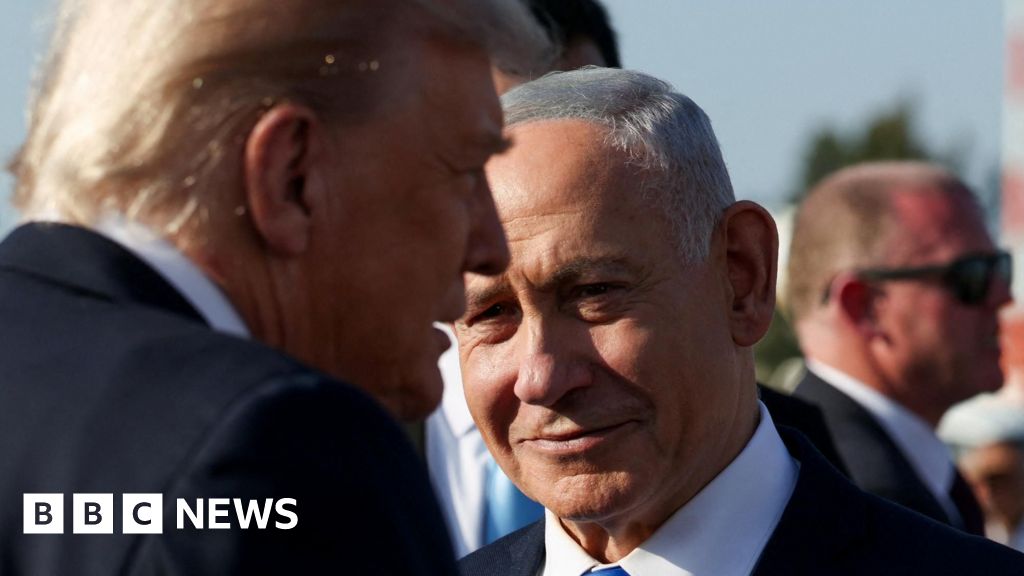
U.S. President Donald Trump will turn his attention to the Middle East on Monday when he hosts Israeli Prime Minister Benjamin Netanyahu in Florida for talks expected to cover Gaza and a range of other pressing issues.
Any decisions made could have potentially significant implications for issues that will determine the region’s future.
The United States has been Israel’s strongest military and political backer during the two-year war in Gaza, and many now see the meeting as a test of the relationship between Israeli leaders and how aligned they are on key issues.
This will be their sixth meeting since Trump returned to office 11 months ago.
Topics expected to be discussed include the future of relations with Syria’s new government, Iran’s rearmament and Hezbollah’s role in Lebanon.
Perhaps most crucially, they will discuss progress on the Gaza ceasefire agreement, in which the Israeli government has taken a different position than the U.S. government.
The talks will take place as storms continue to batter Gaza, where hundreds of thousands of displaced Palestinians still live in crude tents that offer little protection against cold and flooding.
On Monday, the Hamas-run health ministry reported the death of a two-month-old baby from the freezing weather, bringing the death toll from cold weather since Dec. 10 to three, while 17 others died when buildings damaged by the storm collapsed.
The United Nations and numerous aid agencies have accused Israel of continuing to restrict full access to basic supplies and equipment and failing to fulfill its ceasefire obligations. Israel says it is meeting its obligations to facilitate increased aid delivery.
The Trump administration hopes to see the ceasefire enter a second phase in January, which would see the establishment of a Palestinian technocratic government along with the deployment of international security forces, the disarmament of Hamas, the withdrawal of Israeli troops and the start of rebuilding the affected areas.
Critics have suggested Netanyahu may seek to delay progress on a ceasefire, saying he does not want to seriously discuss the Palestinians’ political future and will instead push for the full disarmament of Hamas before Israeli forces withdraw from Gaza. Hamas officials have repeatedly said that its general disarmament should coincide with the process of establishing an independent Palestinian state.
The 20-point peace plan promoted by Trump and signed by Israel and Hamas recognizes Palestinian aspirations for a sovereign state, but Netanyahu and his ministers have rejected Palestinian statehood since a ceasefire took effect in October.
Last week, Defense Minister Israel Katz said his country would build settlements in Gaza and “never fully withdraw” from the territory even if Hamas disarms, despite this being a key principle of the ceasefire agreement.
Many in the region see it as crucial to break the current deadlock, in which Israeli forces carry out deadly attacks in Gaza on an almost daily basis despite a declared ceasefire.
According to the Palestinian Health Ministry, at least 414 Palestinians were killed by Israeli forces in the area within 80 days of the law taking effect.
The Israeli military, which controls more than half of Gaza, said it fired only in response to ceasefire violations.
Three Israeli soldiers were killed in attacks during the same period, which the military blamed Hamas.
Israel continues to wait for Hamas to return the body of Ram Gweli, the last Gaza hostage to die. All hostages, living and dead, taken during the Hamas-led attack on Israel on October 7, 2023, which triggered the war, should be returned three days after the ceasefire comes into effect.
Trump’s intervention and U.S. mediation could resolve worrying and unresolved sticking points, forcing Netanyahu to adopt a softer stance on some positions.
For example, the Israeli government opposes Türkiye’s participation in the International Stabilization Force deployed in Gaza. However, few other countries are willing to participate.
Netanyahu is also expected to meet with U.S. Secretary of State Rubio, who is seen supporting the Israeli government’s stance.
Last week, Israeli media reported that the prime minister might try to reopen the issue of Israel’s annexation of the occupied West Bank, something President Trump has expressed opposition to.
Israeli ministers have recently described the expansion of Israeli settlements in the West Bank as a de facto annexation of the territory aimed at burying the possibility of an independent Palestinian state.
Both settlements and annexations are illegal under international law.
Netanyahu is expected to use Monday’s meeting with Trump to seek U.S. permission for further military strikes against Iran.
The Israeli government is said to believe Iran is rearming its missile capabilities following this summer’s 12-day war, which saw Iran’s nuclear facilities bombed by Israeli and U.S. fighter jets.
Iran’s president said this weekend that Iran is engaged in an “all-out war” with Israel, the United States and Europe. “They don’t want stability in our country,” Masoud Pezeshkian said.




