Physical Address
304 North Cardinal St.
Dorchester Center, MA 02124
Physical Address
304 North Cardinal St.
Dorchester Center, MA 02124

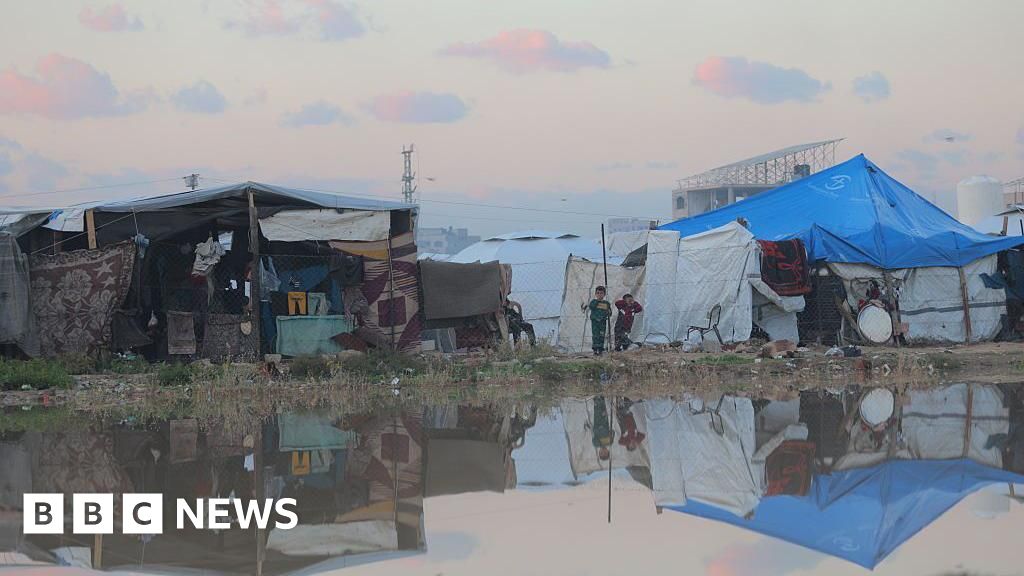
Heavy rains over the past week have worsened already dire living conditions for hundreds of thousands of displaced Palestinians in the Gaza Strip, the United Nations agency said.
Unicef spokesman Jonathan Crickx told the BBC that the weather last night was “terrible”, with the rain falling so hard that he saw up to 15 centimeters (6 inches) of water on the ground near his office.
He said he was extremely concerned that children living in tents and makeshift shelters wearing wet clothes would die of hypothermia and other illnesses.
The Hamas health ministry in Gaza said an infant died of hypothermia and at least 11 other people died after building collapses caused by bad weather.
U.N. agencies have stepped up efforts to deliver tents, blankets and clothing since the Gaza ceasefire began nine weeks ago, but they say there is still not enough aid.
The United Nations and partners estimate that nearly 55,000 families have been affected by the rains so far, with their belongings and shelters damaged or destroyed.
More than 40 designated emergency shelters were severely flooded after torrential downpours on Monday and Tuesday, forcing many to relocate again.
“Last night was really scary for these families,” Jonathan Crickx, Unicef’s director of communications for the State of Palestine, told the BBC’s Today program on Wednesday. “The rain was so heavy that we could see 10 centimeters, 15 centimeters (4-6 inches) of water at times in our offices and hotels. And the winds were very strong.”
“As I was driving this morning, I saw many, many people trying to use buckets to remove some of the water.”
He noted that during the two-year war between Israel and Hamas, most of the estimated one million people living in tents and makeshift shelters were displaced multiple times with little or no change of clothes.
“When I saw (the children) this morning, their clothes were all wet. I could see the parents trying to dry some of their blankets. But it’s been raining pretty much the last four or five days, so it’s very difficult to keep the kids dry,” he said.
“With nighttime temperatures around 7, 8 degrees Celsius (45 to 46 degrees Fahrenheit), we are very worried about children getting sick or, even worse, dying from hypothermia.”
He added that many tents are also at risk of being blown away or destroyed by strong winds brought by the rainfall, as they are simply made of a tarp or plastic sheet nailed to a flimsy wooden structure.
Mr Crix said UNICEF had provided additional assistance during the ceasefire to help children cope with harsh winter conditions, including 250,000 sets of winter clothing, 600,000 blankets and 7,000 tents, but this was not enough.
“We are working tirelessly to bring in and distribute aid, but the scale of need is such that we still have thousands of people and children suffering every night,” he warned.
A two-week-old boy, Mohammed Abu Khair, died of hypothermia on Monday, two days after he was taken to hospital and placed in intensive care, Gaza’s health ministry said. Eleven other people have died so far after the war-damaged buildings where they took refuge collapsed, the report added.
Mahmoud Bassal, spokesman for Hamas’s civil defense agency, said the death toll was higher. He said in the video that a total of 17 people died due to building collapse and cold, including four children.
He added that 17 residential buildings completely collapsed and another 90 partially collapsed due to wind and rain.
Video footage showed on Tuesday civil defense first responders pulling the body of a man from the rubble of a building in the Shadi refugee camp northwest of Gaza City. According to eyewitnesses, its roof suddenly collapsed.
“We call on the world to solve our problems and rebuild the territory so that people can have homes instead of being displaced and living on the streets,” Ahmed Khosari, a relative of the man, told AFP.
The International Committee of the Red Cross said the adverse weather conditions leading to the collapse of damaged buildings were “deeply worrying”.
It stressed the need for “increased and sustained humanitarian assistance to meet emergency and long-term needs, including food, shelter and equipment to repair critical infrastructure”.
Cogat, the Israeli military agency that controls Gaza crossings, dismissed suggestions that aid was being deliberately restricted, saying it was “inconsistent with the facts on the ground and the coordination that is going on every day.”
According to the report, between 600 and 800 trucks carrying humanitarian supplies enter Gaza every day, and nearly 310,000 tents and tarpaulins have been delivered since the ceasefire began, as well as more than 1,800 truckloads of warm blankets and clothing.
The United Nations said a total of 67,800 tents, 372,500 tarps and 318,100 items of bedding had been collected from border crossings during the same period.
The second phase of the ceasefire between Israel and Hamas includes plans for Gaza reconstruction, post-war governance, Israeli troop withdrawal and Hamas disarmament.
The Israeli prime minister said last week that the second phase of the work was nearing completion and that Hamas had returned only the body of an Israeli hostage in Gaza as part of the first phase.
The war was triggered by a Hamas-led attack on southern Israel on October 7, 2023, which killed about 1,200 people and took another 251 hostage.
Since then, Israeli attacks on Gaza have killed more than 70,600 people, according to the region’s health ministry.




