Physical Address
304 North Cardinal St.
Dorchester Center, MA 02124
Physical Address
304 North Cardinal St.
Dorchester Center, MA 02124

Event Summary: US military action triggers market volatility
In the early morning of Saturday (January 3), the United States launched a large-scale military operation code-named “Operation Unleash Resolve” against Venezuela. The operation included air strikes on multiple military targets and resulted in the successful arrest of the Venezuelan president and his wife. As a result, the U.S. Department of Justice filed multiple charges against the detainees, including “terrorist conspiracy to traffic drugs.” The United States has announced that it will temporarily take over Venezuela until the safe transfer of power is completed.
This unexpected incident was one of the largest geopolitical interventions in the Western Hemisphere in recent years, attracting widespread attention and sparking controversy from the international community. After this incident, market risk aversion increased significantly, directly supporting traditional safe-haven assets such as gold.
Market reaction: gold price analysis
Short-term risk aversion direction:
After the incident, gold, a traditional safe-haven asset, saw an inflow of funds.
By 2025, gold prices will have risen by nearly 65%, closing at around $4,333 an ounce last Friday.
Geopolitical uncertainty has increased gold’s appeal as a safe-haven asset.
Technical performance:
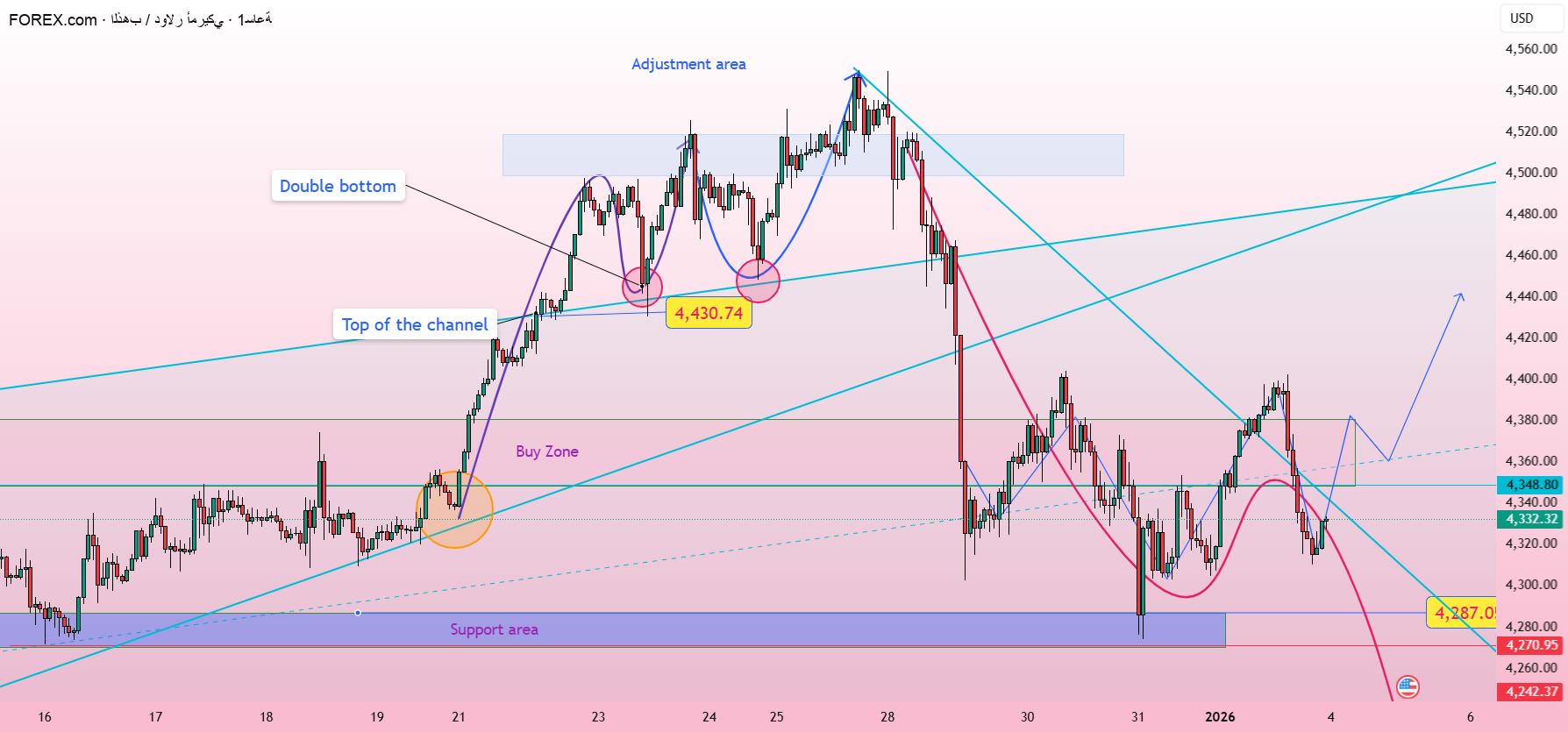
Gold prices tested the key resistance level of $4,400 on Friday but failed to effectively break through.
It fell sharply in the evening, hitting a low of $4,308, with intraday fluctuations of nearly $100.
The $4,400 level shows strong resistance, forming short-term technical resistance.
Outlook: Complicating factors
Supporting factors rise:
The geopolitical risk premium remains.
The global risk aversion trend is unlikely to weaken rapidly in the short term.
Technically, there is support at the $4,300 level.
Downside risk factors:
Military operations are relatively short-lived and have limited long-term impact.
Strong technical resistance lies above $4,400.
If the situation does not worsen, buying may gradually become a safe haven. Main technical level:
Resistance levels: $4366, $4384, $4403 (last week’s high).
Support level: $4,300 (psychological level).
Key turning point: A decisive break below $4,300 could open the way for further losses.
Trading strategy advice
Short term strategy:
Watch for market performance when the market opens on Monday. If the market opens higher due to the event, keep an eye on the resistance area between $4,366 and $4,384.
Riskier traders may consider opening a small sell position in the resistance area, placing a stop-loss order above $4,403.
Conservative traders should wait for the price to fall back to support around $4,300. Once stable, it is recommended to consider opening a short-term buy position.
Risk warning:
Geopolitical events create uncertainty and can cause significant market volatility.
It is recommended to carefully control the position size to avoid being carried away by short-term trends.
Pay attention to the trend of breaking through the $4300-4400 range.
Long-term outlook: The logic of investing in gold remains unchanged
Looking forward to 2025, driven by multiple factors such as macroeconomic uncertainty, inflationary pressure, and geopolitical risks, the gold market will show a strong upward trend. This confirms gold’s value as a safe-haven asset and its hedging role in asset allocation.
Entering 2026, the gold market will continue to be affected by the following fundamental factors:
The evolution of global macroeconomic cycles
Monetary policy paths of major central banks
Changing geopolitical landscape
US dollar index trend
real interest rate level
Expert tip: In gold market investing, controlling emotions is often more important than technical analysis. In the current market environment, investors should:
Avoid chasing highs and lows: Market movements driven by geopolitical events tend to be highly volatile and have limited sustainability.
Risk Management Commitment: Avoid overly large position sizes on a single trade and clearly define stop loss orders.
Get the rhythm of the market: Watch for transitions between bullish and bearish trends at key support and resistance levels.
Think long-term: Don’t let short-term events change your long-term asset allocation logic.
Bottom line: Fifteen years of market experience has taught me that there are no fixed rules or foolproof predictions when it comes to gold investing. It’s a constant learning of market patterns, a rigorous commitment to risk management, and the constant development of a mindset. Every market trend has a different story, but the logic of profit is the same: stay calm amidst the market noise and stick to principles amidst fluctuations.
If you are on this path and are eager to make steady progress while avoiding common mistakes, I would like to share the practical experience, technical systems, and risk management techniques I have accumulated over the years. Investment is not a speed race, but a marathon that tests patience and wisdom. In 2026, let us continue to move forward side by side. In this market full of opportunities and challenges, rationality enlightens our path and discipline protects our profits. The road may be long, but as long as we persevere, we will reach our destination. The task may be difficult, but determination will ensure success.