Physical Address
304 North Cardinal St.
Dorchester Center, MA 02124
Physical Address
304 North Cardinal St.
Dorchester Center, MA 02124

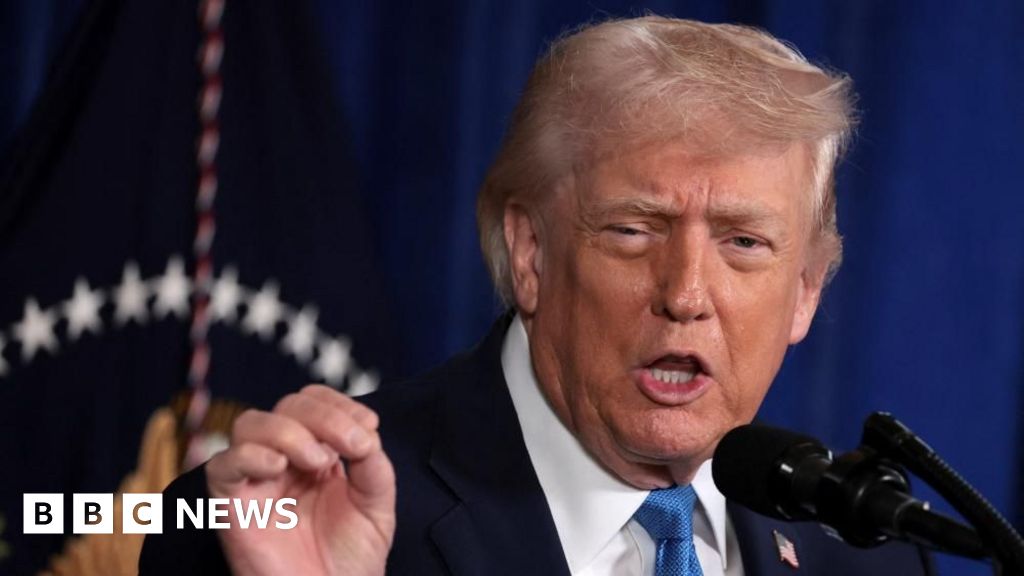
After a US attack led to the arrest of Venezuelan President Nicolas Maduro, Donald Trump said the United States would “manage” Venezuela until a “safe, appropriate and wise transition” could be ensured.
The US president said US oil companies would also repair Venezuela’s “broken infrastructure” and “start making money for the country”.
The United States launched an attack on Venezuela on Saturday morning, with Maduro and his wife, first lady Celia Flores, captured and taken out of the country by US forces.
Venezuela has declared a national emergency and condemned “military aggression”, with the country’s vice president describing Maduro as the country’s only leader.
Maduro and Flores left the capital, Caracas, aboard a U.S. helicopter early Saturday morning and boarded the USS Iwo Jima at an unknown location in the Caribbean.
They were then airlifted to the U.S. Naval Base at Guantanamo Bay, Cuba, then transferred to another plane to New York state and then flown by helicopter to New York City’s Metropolitan Detention Center in Brooklyn.
U.S. Attorney General Pam Bondi said Maduro and Flores had been indicted in the Southern District of New York.
The pair were charged with conspiring to commit narco-terrorism and importing cocaine, possessing machine guns and destructive devices, and conspiring to possess machine guns and destructive devices against the United States.
“They will soon face the full wrath of American justice in American courts on American soil,” Bundy wrote on X.
Previously, Maduro strongly denied that he was the leader of the cartel and accused the United States of using the “war on drugs” as an excuse to try to overthrow him and gain access to Venezuela’s huge oil reserves.
“Venezuela’s oil business is bankrupt, completely bankrupt for a long time,” Trump said at a news conference before Maduro arrived in New York.
“We’re going to have our very large U.S. oil companies, the largest oil companies in the world, step in and spend billions and billions of dollars to repair badly damaged infrastructure, oil infrastructure, and start making money for the country.”
The South American country holds about 303 billion barrels of crude oil, accounting for about 20% of the world’s oil resources, according to the U.S. Energy Information Administration.
It’s unclear how the United States plans to “manage” Venezuela, but the president said it would be led by a “group of people.”
“We’re going to run it with a team and we’re going to make sure it runs properly,” Trump said.
When pressed by reporters on who in Venezuela would be part of the group, Trump said Secretary of State Marco Rubio had been talking to the country’s Vice President Delcy Rodriguez.
Trump said Rodriguez had expressed a willingness to do “anything the United States asks.” Rodriguez was later appointed interim president by Venezuela’s Supreme Court.
However, after Trump’s speech, Rodriguez spoke on state television, calling Maduro “the only president Venezuela has” and adding that the government was ready to defend itself.
Trump also said he had not yet spoken to Venezuelan opposition leader Maria Colina Machado, who was barred from running in last year’s presidential election but played an important role in rallying support for Maduro’s rival candidate, which Maduro is believed to have won.
The U.S. president said Machado “does not have the support or respect he needs to govern Venezuela.”
Early Saturday morning, explosions were heard around Caracas and a military base was attacked by US forces. Over the next two hours and twenty minutes, dozens of U.S. planes flew through the skies as special forces penetrated Maduro’s safe house to rescue him.
Venezuela’s long-time allies strongly condemned the U.S. actions. Russia accused the United States of committing “acts of armed aggression” that were “deeply worrying and condemnable.” China’s Foreign Ministry said it was “deeply shocked and strongly condemned” by the use of force against a sovereign country and its president.
Many Latin American countries, including Venezuela’s neighbors Colombia and Brazil, also condemned the actions. Cuban President Miguel Díaz-Canel described it as a “criminal attack,” while Trump’s Argentinian ally Javier Mire wrote on social media that “freedom moves forward.”
U.S. allies have reacted more conservatively, urging a peaceful transition of power. Sir Keir Starmer said the UK “believes Maduro is an illegitimate president” and “shed no tears at the end of his regime” but called for a “safe and peaceful transition to a legitimate government”.
Similar calls for peace were echoed by the EU’s top diplomat Kaya Callas and French President Emmanuel Macron. Macron wrote in a post on X that the new government must “respect the will of the Venezuelan people.”
German Chancellor Friedrich Merz said the legality of U.S. actions was “complex” and warned that “political instability in Venezuela must not be allowed.”
Maduro’s capture is the culmination of an escalating pressure campaign by the Trump administration over the past 12 months that has included sanctions and sanctions on his administration. Deploy a large number of naval forces in the area.
Since September, the United States has launched more than 30 attacks on vessels in the Pacific and Caribbean allegedly used for drug trafficking, killing more than 100 people.
The Trump administration has described the attack as targeting terrorists trying to bring fentanyl and cocaine into the United States, but has provided no evidence for that claim.
The identities of those on board have not been made public except for two survivors, a Colombian and an Ecuadorian.
Earlier this week, the conflict escalated further US military launches air raid on “Dockside” Related to suspected Venezuelan drug trafficking ship.
Fentanyl is produced primarily in Mexico and reaches the U.S. almost exclusively overland via the southern border.
Counter-narcotics experts also describe Venezuela as a relatively small player in global drug trafficking, primarily smuggling drugs produced elsewhere through one country.